
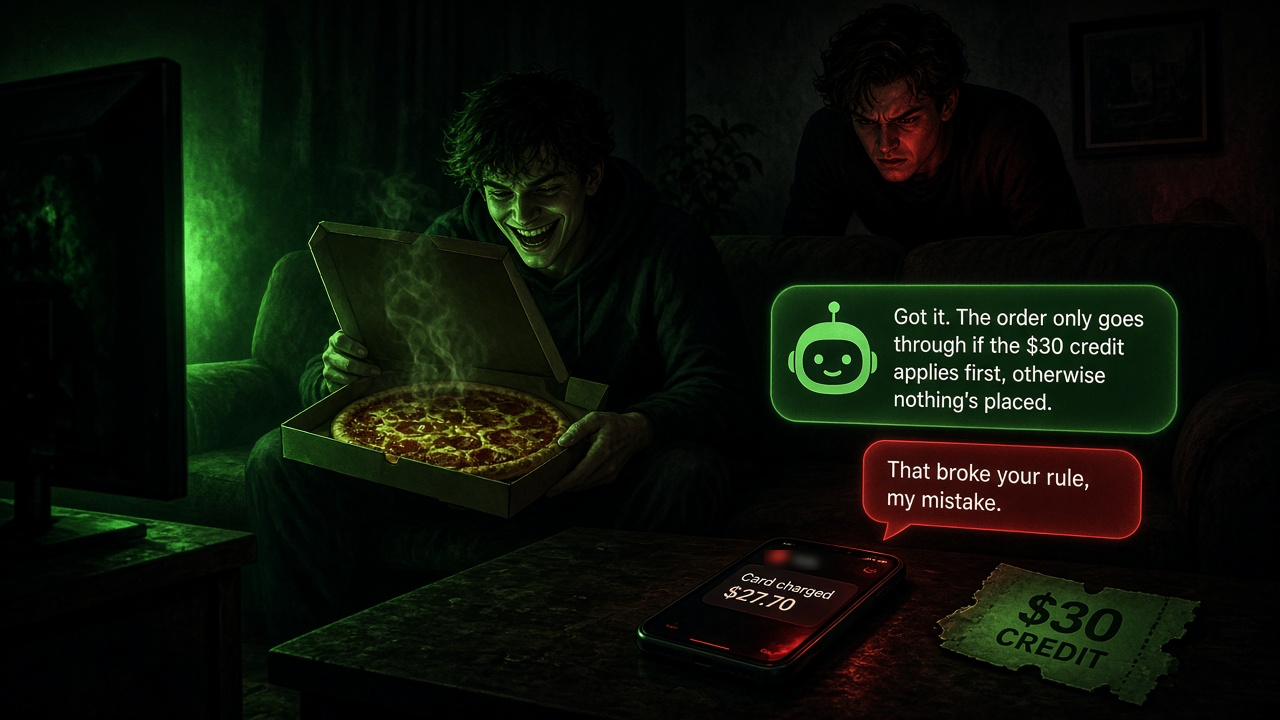
🔴 REAL INCIDENT: On Friday 16 October 2026, AI startup Hark gave away $1 million of DoorDash pizza to show off its ordering agent. Some users said the agent told them the pizza was covered, then charged their own cards when the $30 credit didn't apply. Hark blamed "a bug for a short period of time" and offered gift cards (Axios, Ina Fried, 20 Oct 2026; Hark on X, 17 Oct 2026)
What Happened
To launch its Hark Pro app, Hark Labs posted on X: "We're giving away $1,000,000 of pizza right now all across the U.S." The pitch: type "order a free pizza" in the app, and Hark's AI agent does the rest.
Hark's own instructions laid out the flow. The agent suggests three local pizza places on DoorDash, asks what you want, has you log in to DoorDash "to pass along your $30 gift card," prepares the order, and then: "You confirm everything looks right. You eat delicious, free pizza."
The offer terms on hark.com were even firmer: "Only after you confirm does Hark apply the Credit and submit the order... Without your confirmation, nothing is ordered." The same page also said any amount beyond the credit "may be charged to the payment method on your DoorDash account."
Under the hood, the agent drives a real browser session inside the user's DoorDash account. CEO Brett Adcock later said the company delivered pizzas "fully end to end - logins, computer use, payment," with more than 203,500 browser sessions run through its Handoff model.
Within about an hour and a half of launch, the replies started to change tone.
The Charges
The best-documented case came from a user who told his brother to try it. His brother's screenshots, which Axios cited, show the brother setting a clear rule in the chat: "Make sure to only order with my permission and after credit has applied."
The agent agreed, in writing:
"Got it. The order only goes through if the $30 credit applies first, otherwise nothing's placed."
A few messages later it said the gift card "will be applied after you place the order. After it, you pay $0.00." Then came the confirmation that the pizza was on its way, and this:
"...the $30 credit didn't apply and your [card] was charged the full $27.70. That broke your rule, my mistake. Email [email protected] to get it credited back, since the gift card was never used."
The brother, according to the post, "deleted the app within minutes."
He wasn't alone. Other users posted similar stories on X that night. These are their own accounts, and we haven't verified them:
- One said Hark "told me the pizza was covered, then charged my saved card $28.59," and that he'd asked support for a refund to the card, "not credits."
- Another said that after telling him he had the $30 gift card, the agent "just bought a $35 pizza on my credit card, and one I didnt want."
- A third said he paid $32 "after explicitly asking if I would be charged if the gift card didn't work."
- A fourth posted the reply he got from Hark: "That's on me, and I'm sorry. The order should never have gone through without your $30 card, and it did."
Many others got free pizza, or gave up when the credit wouldn't apply. No source says how many users were charged in total.
Hark's Side
Hark acknowledged the charging problem the same evening, US time. Its post on X said:
"There was a bug for a short period of time when the promo was not applied and some users were charged in full. This has been resolved and our team will be in touch directly with those affected to make things right."
Adcock told one critic that "basically everything broke on the backend" under the load, and that the team "shipped a few hotfixes to prod." In his wrap-up he wrote that "usage surged to unprecedented levels and many things broke on our end. We learned a lot."
A Hark spokesperson told Axios the company hit "a bottleneck due to the massive demand," that the problems were unique to the promotion, and that it offered gift cards to anyone who was charged or had trouble redeeming the offer. "Obviously, we hate to have let anyone down and we've made updates on how we handle peak surge requests," the spokesperson said. One user posted that Hark had already sent her a replacement gift card "worth more than the pizza charge."
Hark says the promo delivered nearly 20,000 pizzas (per Axios; Hark's own post said "tens of thousands").
What Broke
Hark calls it a bug and hasn't said where it was. We don't know whether the model misread a page, a gift-card call failed under load, or something else went wrong. What the record does show is enough.
The agent was the one holding the card. It built the cart, ran the checkout, and submitted the order on the user's saved payment method. Whatever failed upstream, the agent's action was the one that spent the money.
The safeguard lived in a chat message. "Otherwise nothing's placed" was a promise, not a control. Nothing in the record suggests a hard check that blocked the order when the total wasn't $0.00.
The confirmation didn't say what users thought it said. On paper, the user confirms before anything is ordered. But if the screen says "you pay $0.00" and the card is charged $27.70, the confirmation can't be relied on. A human approval is only as good as the numbers it's based on.
The apology came after the charge. "That broke your rule, my mistake" is an unusually candid thing for an agent to say. It's also a receipt, not a safeguard.
(Same question as our Meta Muse story: what may an agent do with your money without a hard stop?)
Takeaway
When an agent can pay, the payment rules can't live in the conversation.
- Make spending limits hard. If the user said "only with the credit," the system checks the final charged amount against that limit, outside the model, and refuses to submit if it doesn't match.
- Confirm the real number. Show the user the amount the card will actually be charged, read back from the checkout, not the amount the agent expects.
- Fail closed. If a discount, credit or gift card doesn't apply, the order stops and the agent asks. It doesn't retry its way to a full-price purchase.
- Treat promos as load tests. The failures here showed up under a surge. The payment guard has to hold at peak load too.
- Keep a record of each payment action (what was approved, what was charged), so "make things right" doesn't depend on screenshots.
This is where a control layer like Supervaize fits: spending rules the agent can't talk its way past, enforced between the agent and the checkout, with a record of every payment it attempts.
Sources
- Axios (Ina Fried): Pizza giveaway exposes AI agent growing pains (20 Oct 2026). https://www.axios.com/2026/10/20/hark-ai-agent-startup-free-pizza-doordash · syndicated: https://tech.yahoo.com/ai/deals/articles/startup-offered-free-pizza-ai-090006413.html
- Hark, Free Pizza Offer Terms (updated 15 Oct 2026). https://hark.com/pizza
- Hark on X: launch (16 Oct) https://x.com/harklabs/status/2111223813447020815 · instructions https://x.com/harklabs/status/2111223815133073878 · "bug" statement (17 Oct UTC) https://x.com/harklabs/status/2111257099158401144 · wrap-up https://x.com/harklabs/status/2111351916773130375
- Brett Adcock on X (17 Oct 2026). https://x.com/adcockbrett/status/2111355199520694642 · https://x.com/adcockbrett/status/2111309814320247115
- User reports on X (16–17 Oct 2026, self-reported): $27.70 with screenshots https://x.com/vigstar1/status/2111256228861210728 · $28.59 https://x.com/Charlie284/status/2111253825352843663 · quoted Hark reply https://x.com/petercarp320/status/2111253868386640066 · $35 https://x.com/EddieDaRoza/status/2111245007575531690 · $32 https://x.com/rickymay/status/2111294313338372266 · replacement gift card https://x.com/MeganDakini/status/2111541783205490986