
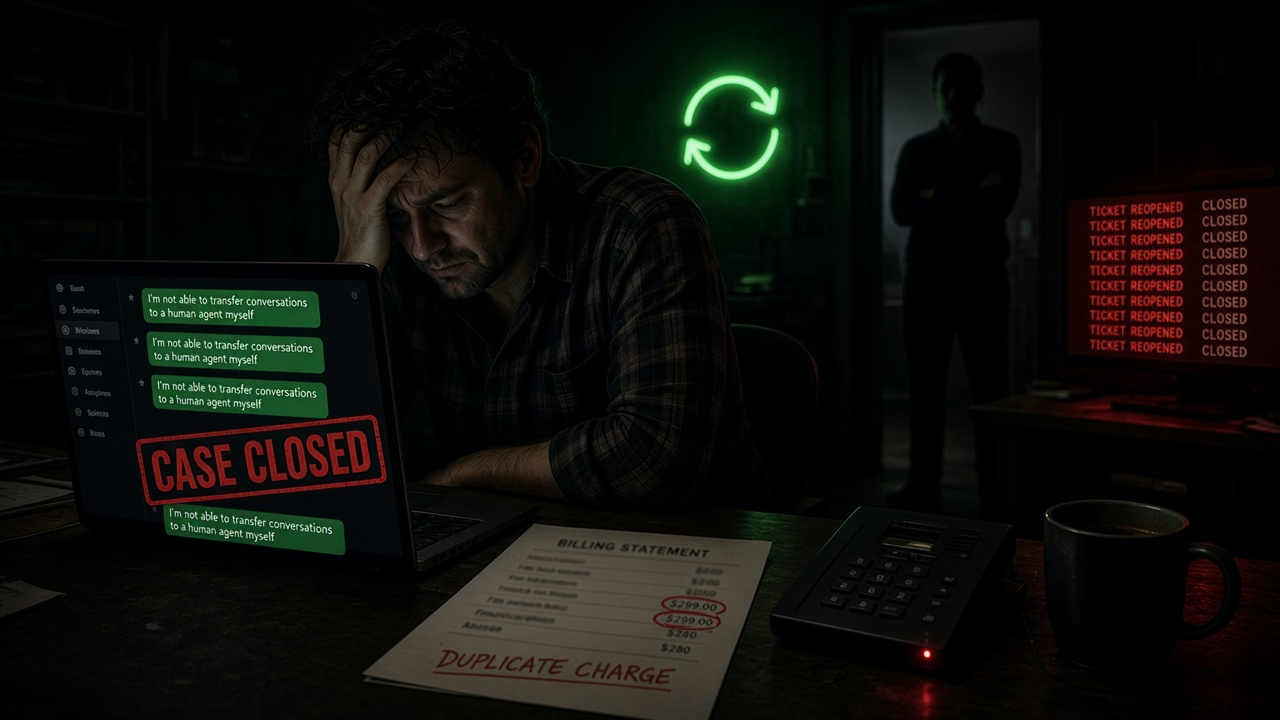
🔴 REAL INCIDENT: Six paying Anthropic customers told the San Francisco Standard they spent weeks in circular chats with Fin, the AI support agent Anthropic uses, over billing errors. Only two ever reached a person, and only by email. Neither Fin nor Anthropic responded to the paper's questions (SF Standard, Helen Li, 15 Oct 2026)
What Happened
Anthropic is one of Fin's showcase customers. In a testimonial on Fin's website, Anthropic support ops lead Isabel Larrow says: "We've been seeing around 560,000 resolutions a month with Fin, which is incredible when you think of all the conversations that are not funneling to our human team." The same page puts Fin's resolution rate at 79% and says Fin handles 63% of Anthropic's total support volume end to end.
The San Francisco Standard went looking for the other side of that number. It spoke with six Anthropic customers who had billing and refund problems. Most waited weeks for a fix. Only two ever reached a person, and only by email. Screenshots of their chats show circular conversations that, in the paper's words, "can fail to address the problems raised by the customers."
The $3,500 duplicate. A CEO of a Canadian engineering firm, identified only as "DC," bought a Claude subscription for his 15-person team. Anthropic created a duplicate account and charged him an extra $3,500. He expected a quick refund. Instead, the Standard reports, it turned into "a months-long ordeal," with weeks of circular conversations with Fin that didn't solve the problem.
He eventually asked American Express for a chargeback. After that, according to the Standard, Anthropic didn't cancel the duplicate subscription or issue a refund. Anthropic cancelled DC's team account. That disrupted his team's work and forced him to pay for a new subscription. The report doesn't say whether that cancellation was made by a person or an automated system, so we don't attribute it to the AI.
The card that wouldn't stop. "Tom," 33, runs a startup from his Bay Area home. When he tried to upgrade his Claude plan, Anthropic kept charging an old card. The Fin agent sympathized, then closed the case. Its words:
"I understand how frustrating it must be to see repeated billing attempts on a card you've already removed, especially with the urgency involved here. I'm not able to transfer conversations to a human agent myself, but I can keep working through this with you directly."
The $200 annual switch. "David," a tech professional in his 30s, says he was mistakenly charged $200 when Claude moved him to an annual plan. Fin promised a reply within 24 hours that never came. His bank in Taiwan had to suspend his card to dispute the charge.
Similar self-reported complaints show up on Anthropic's public claude-code GitHub tracker, where some users post billing disputes because, they say, Fin told them it couldn't escalate. Those posts are unverified, and the repository's bot labels them off-topic.
Anthropic's and Fin's Side
Fin did not respond to the Standard's request for comment. Anthropic did not respond to a question about how many humans oversee its support team. We found no other public statement from either company as of 17 October 2026.
What Anthropic does publish is its support policy. Its help center says support is written only, through the messenger and email, with no phone or live chat. Pro and Max subscribers, Team and Enterprise owners, and Console admins have access to a Product Support team. If an issue needs it, "Fin will pass your inquiry along," and the team replies in the same thread. For Team plan members who aren't owners, the help center says plainly: "Human specialist support is not directly available for your account seat type." An owner or admin has to escalate for them.
So on paper, there is a route to a human for paying subscribers. The customers in the Standard's story describe not finding it, or Fin not taking them there.
How the Escalation Is Supposed to Work
According to the Standard, companies like Anthropic set the rules in Fin for when a case goes to a person. Fin detects "sentiment," and "frustrated" includes complaining about a charge or repeating a request. At that point, the ticket is supposed to go to an inbox for human review.
How Fin is paid matters here. Fin's public pricing is $0.99 per "outcome." Its billing documentation counts two kinds:
- Resolution: the customer confirms the answer helped, or leaves for 24 hours without asking for more help (an "assumed resolution").
- Procedure handoff: Fin completes a workflow that the customer configured to end with a human. This is also billed at $0.99.
Not billed: escalations under Fin's default behavior, when the customer asks for a human or Fin detects frustration, and escalations under workspace-wide rules.
The Standard summarized this as Anthropic paying 99 cents per AI resolution and nothing when a case goes to a person. That's roughly right for default escalations, but configured handoffs are billable too. Anthropic's actual contract terms aren't public.
The Enterprise Angle: Design and Incentives
Nothing here requires a villain. It takes three ordinary decisions.
1. Escalation is configuration. The buyer, not the vendor, decides which conversations reach a person and who's allowed to ask. If billing disputes aren't a hard trigger, or the person asking doesn't have the right seat type, the agent can keep "working through this with you directly" indefinitely.
2. Outcome pricing makes "gave up" look like "solved." Under the published model, a customer who walks away without asking again is counted and billed as an assumed resolution. Your resolution rate goes up. Your dashboard can't tell a happy customer from an exhausted one. Fin's own documentation recommends setting escalation rules so frustrated customers are handed off rather than left to become assumed resolutions.
3. Money disputes don't stay in the chat. When the agent loop doesn't fix a charge, customers go to their card issuer. DC went to Amex. David's bank suspended his card. Chargebacks bring fees, account actions, and lost customers. They land in finance and legal, not in a support metric.
The Law Arriving in January
On 28 September 2026, Gov. Gavin Newsom signed AB 1609, the Right to Human Customer Service Act by Assemblymember Rick Chavez Zbur (Chapter 733, Statutes of 2026). It takes effect on 1 January 2027. As enacted, it:
- Covers businesses with more than $500 million in gross annual revenue nationally that provide goods and services to customers in California.
- Bars them from presenting a customer service chatbot as a human, and requires disclosure where people could be misled.
- Requires, during regular business hours, a simple way to ask for a human agent, and a good-faith effort to connect the customer within 15 minutes of the request, or to give them an appointment within one business day.
- Excludes requests made by email, web form or voicemail from the 15-minute rule, and doesn't require companies without phone support as of 1 January 2027 to add it, provided they offer a way to "promptly connect" with an agent.
- Is enforced by public prosecutors, with civil penalties of up to $5,000 for an initial violation and $10,000 for each subsequent one. There is no private right of action.
Zbur told the Standard: "If AI was running the customer service platform and you can't get it resolved with the AI, they would actually have to transfer you to a human being that would continue providing service through the chat function." Whether and how the law applies to any particular company is for regulators and courts to decide.
Takeaway
Anthropic's testimonial celebrates the conversations that never reach its human team. Its customers' stories, as the Standard reported them, show what that costs when the conversation is about money.
The lesson for anyone deploying a support agent:
- Make money disputes a hard escalation trigger. Duplicate charges, refunds and failed cancellations go to a person, by rule, every time. The model's judgment shouldn't decide it.
- Treat "I want a human" as a command, not a sentiment. It should route the same way every time, whatever the customer's seat type.
- Read your vendor's billing definitions. Know what you pay for: a real resolution, an assumed one, or a handoff. Check whether your contract rewards keeping people away from humans.
- Measure exhaustion. Track repeat contacts, reopened cases and chargebacks next to the resolution rate.
This is where a control layer like Supervaize fits: escalation rules that behave the same way every time, with a record of every handoff the agent made, or didn't make.
Sources
- San Francisco Standard (Helen Li): Anthropic uses AI to dodge customer complaints. A new law may force a change (15 Oct 2026). https://sfstandard.com/2026/10/15/anthropic-customer-service-human/ Primary source. Six customers, DC / Tom / David accounts, Fin quote, no-comment lines, Zbur quotes.
- Fin: AI-first by design: How Anthropic transformed support operations with Fin. https://fin.ai/customers/anthropic-transformation. Anthropic's 560k-a-month, 79% and 63% figures and the Larrow quote.
- Fin Help Center: Fin pricing: Outcomes. https://fin.ai/help/en/articles/13975800-fin-pricing-outcomes, and https://fin.ai/pricing. $0.99 per outcome; billable vs non-billable escalations; assumed resolutions.
- Claude Help Center: How to get support. https://support.claude.com/en/articles/9015913-how-to-get-support. Anthropic's documented support routes.
- Salesforce: Salesforce Completes Acquisition of Fin (10 Sep 2026). https://www.salesforce.com/news/press-releases/2026/09/10/salesforce-completes-acquisition-of-fin/
- California AB 1609, Chapter 733, Statutes of 2026 (chaptered text). https://leginfo.legislature.ca.gov/faces/billTextClient.xhtml?bill_id=202520260AB1609
- Office of Assemblymember Zbur: Californians Gain Right to Human Customer Service Under New Zbur Law (29 Sep 2026). https://zbur.asmdc.org/press-releases/20260929-californians-gain-right-human-customer-service-under-new-zbur-law