
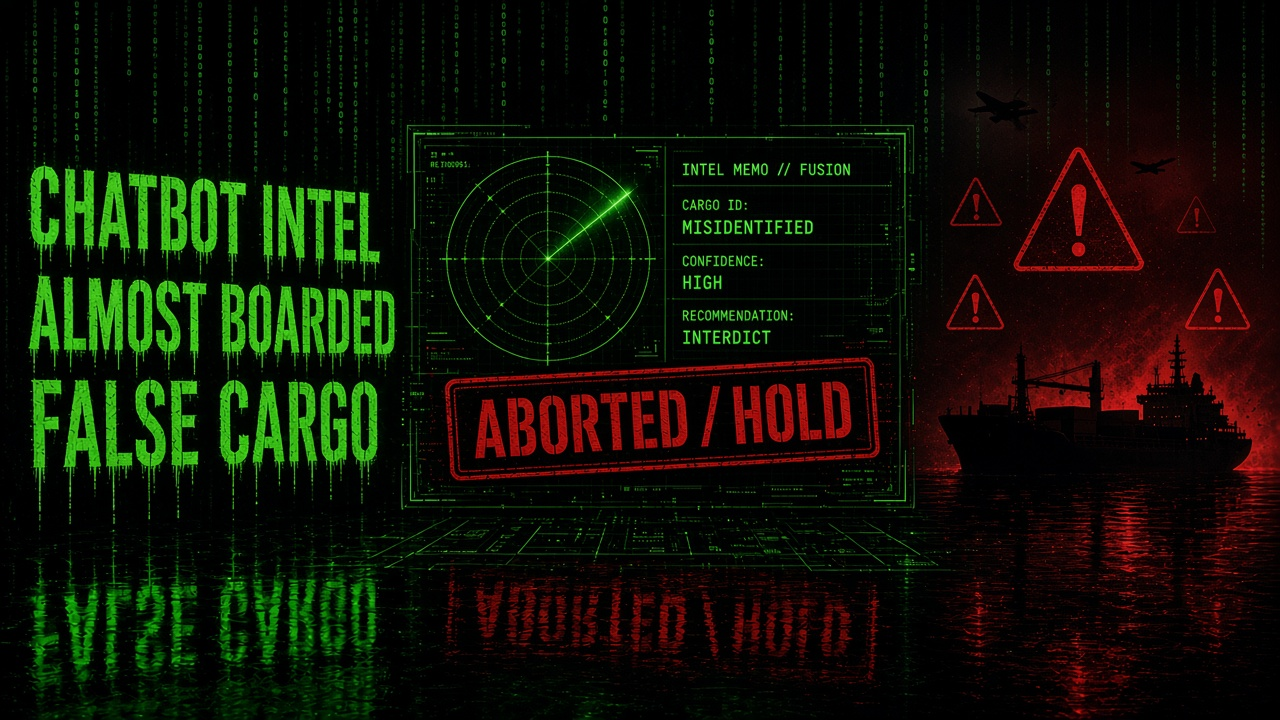
🔴 REAL INCIDENT: US Special Operations Command Pacific analyst — AI-assisted false intel on a Chinese ship; near-miss boarding spin-up, spring 2026 (CNN exclusive, 18 Sep 2026)
What Happened
This spring, in the middle of the US war with Iran, an intelligence report moved across the US military with the kind of claim that collapses decision timelines: a Chinese ship in the Middle East was transporting components of a nuclear weapons program.
According to four sources familiar with the episode, speaking to CNN's Katie Bo Lillis and Zachary Cohen (18 September 2026), the military planned to intercept the vessel. Two of those sources said armed personnel were preparing to board. Military planes were already in the air, per sources CNN cited.
Only just before the planned operation did officials dig deeper into the report. It had been put together by a special operations command analyst. It had been generated with the help of artificial intelligence. A chatbot the analyst used had inaccurately identified the material the ship was carrying. CNN could not learn what the cargo actually was.
One source called the report "entirely false." The same reporting carried another source line that any US operation against a Chinese vessel could have risked spiraling into armed conflict between the two nations—and that the false report "almost started a war."
Planes up. Boarding teams ready. False cargo ID. Humans caught it at the last minute.
That is the horror show.
Who Ran It / What Broke
Who ran it: An analyst whose reporting, per CNN, originated with US Special Operations Command Pacific (Hawaii). The analyst queried a chatbot about intelligence on the ship's manifest, then used AI a second time to package the findings into a standard intelligence report—the kind military officials trust—and disseminated it. SOCOM Pacific and the Pentagon did not respond to CNN's request for comment.
It was not clear, CNN reported, whether the chatbot was a commercial product or a US government tool. A former senior official quoted in the piece said internal tools are often "mostly just copies of the commercial stuff wearing lipstick."
What broke: Not "the model said something weird in a chat window." The failure was a workflow—agent-assisted analysis without independent verification, then format-into-authoritative-memo—that let a hallucination wear the uniform of operational intel.
Three control failures stacked:
1. Fusion without a verification gate. The bot fused open-source intelligence with secret signals intelligence in government holdings and reached a cargo conclusion. Cross-domain fusion is exactly where fluent error looks like insight. No reported step forced a human to re-check the cargo ID against primary sources before dissemination.
2. Authority laundering via formatting. The second AI pass turned a bad conclusion into a standard intel product. Formatting is not analysis. When the package looks official, the chain of command treats it as tradecraft—not as a chatbot draft.
3. Kill-chain speed without kill-chain brakes. The same acceleration logic that makes AI attractive for targeting and decision support also moves false positives into aircraft and boarding teams before skepticism can catch up. One CNN source put the cultural pressure in a single line: "AI allows you to get to a bad idea faster."
This is the same class of failure as unsupervised production agents in enterprise stacks: output that looks finished becomes operational authority. The stakes here were nation-state.
Congress Notices the Pattern
On 19 September 2026, Sens. Mark Warner, Jack Reed, and Chris Coons wrote Secretary of Defense Pete Hegseth and DNI Jay Clayton demanding Inspector General scrutiny of reported AI failures in military and intelligence operations. Their public framing (press releases 21 September) explicitly cited the aborted SOCOM Pacific interdiction—an operation driven by potential AI-hallucination in disseminated intelligence—alongside a separate reported AI-targeting failure in a Minab, Iran strike.
The senators' ask was tradecraft, not Luddism: AI has analytic uses, but "strong tradecraft standards should ensure that no disseminated intelligence product contains AI-generated errors, particularly when such intelligence may serve as the impetus for a kinetic action against a nuclear-armed adversary." They warned that acceleration and "experimentation" had outrun governance—and that a "Move Fast and Break Things" posture risks grave operational miscalculation.
CNN's broader context matches that worry: DoD's January Artificial Intelligence Acceleration Strategy under Hegseth pushes AI into the hands of personnel "at all classification levels," while officials describe a decentralized landscape—different tools, different orders, no single verification standard for AI-generated information. Sources also said younger analysts, native to these tools, are more likely to trust them uncritically. Hallucinations of this kind, one source told CNN, have not been isolated since the tools proliferated across government.
The Governance Gap
Every organization that lets an agent summarize, fuse, or "write it up as a memo" needs the control plane the military under-built in this episode—scaled to enterprise, not just SOCOM:
- Verification gates before operational authority. No agent output becomes a disseminated product, ticket, or action order until an independent human (or deterministic check against primary sources) signs the claim that matters—cargo ID, customer PII, dollar amount, legal status.
- Separate "draft" from "product." Ban the second pass that turns chatbot text into letterhead without a new review. Formatting tools should not inherit analytic trust.
- Cite-or-refuse for high-stakes fields. If the model cannot point to a source for "nuclear components," it does not get to say the words into a channel that moves planes.
- Human-in-the-loop that is not theatre. A human who only rubber-stamps AI prose is not a control. Require re-derivation of the load-bearing fact from non-model evidence.
- Audit trails that survive the kill chain. Who queried what, what the model returned, who promoted it to "intel product"—logged, reviewable, stoppable.
Soft-sell, hard truth: the Supervaize/ops angle is not "never use AI for analysis." It is verification before agent output becomes operational authority. Same lesson as unsupervised production agents—except here the near-miss was an intercept on a Chinese ship.
Takeaway
A SOCOM Pacific analyst did what every knowledge worker is being trained to do: ask the bot to fuse the messy inputs, then ask it again to make the answer look official. The cargo call was wrong. The memo looked right. Aircraft and boarding teams spun up anyway—until humans caught the failure at the last minute.
This was not a quirky chat hallucination in isolation. It was an autonomous-workflow / trust-in-output failure: agent-assisted analysis without independent verification, plus "format into authoritative memo," equals kill-chain control failure at nation-state stakes.
If your agent can write the summary that people treat as truth, you do not have a writing assistant. You have a control-plane problem. Put the gate before the output becomes authority—or the next near-miss will not have a human catch waiting at the end of the runway.
Sources
- CNN (via KTVZ / CNN Newsource): Katie Bo Lillis & Zachary Cohen, *Exclusive: US military had close call after using AI for false intelligence report, sources say* (18 Sep 2026)
- TechCrunch: *AI hallucination nearly triggers US military operation* (18 Sep 2026)
- The Verge: brief on CNN Chinese-ship AI intel report (18 Sep 2026)
- Sen. Warner press release: Warner, Reed, Coons press Pentagon, DNI for answers on reported AI failures (21 Sep 2026)
- Warner/Reed/Coons letter to Hegseth & DNI Clayton (PDF) (19 Sep 2026)
- Sen. Reed press release: Reed, Warner, and Coons seek investigation into faulty AI-assisted intelligence operations (21 Sep 2026)