
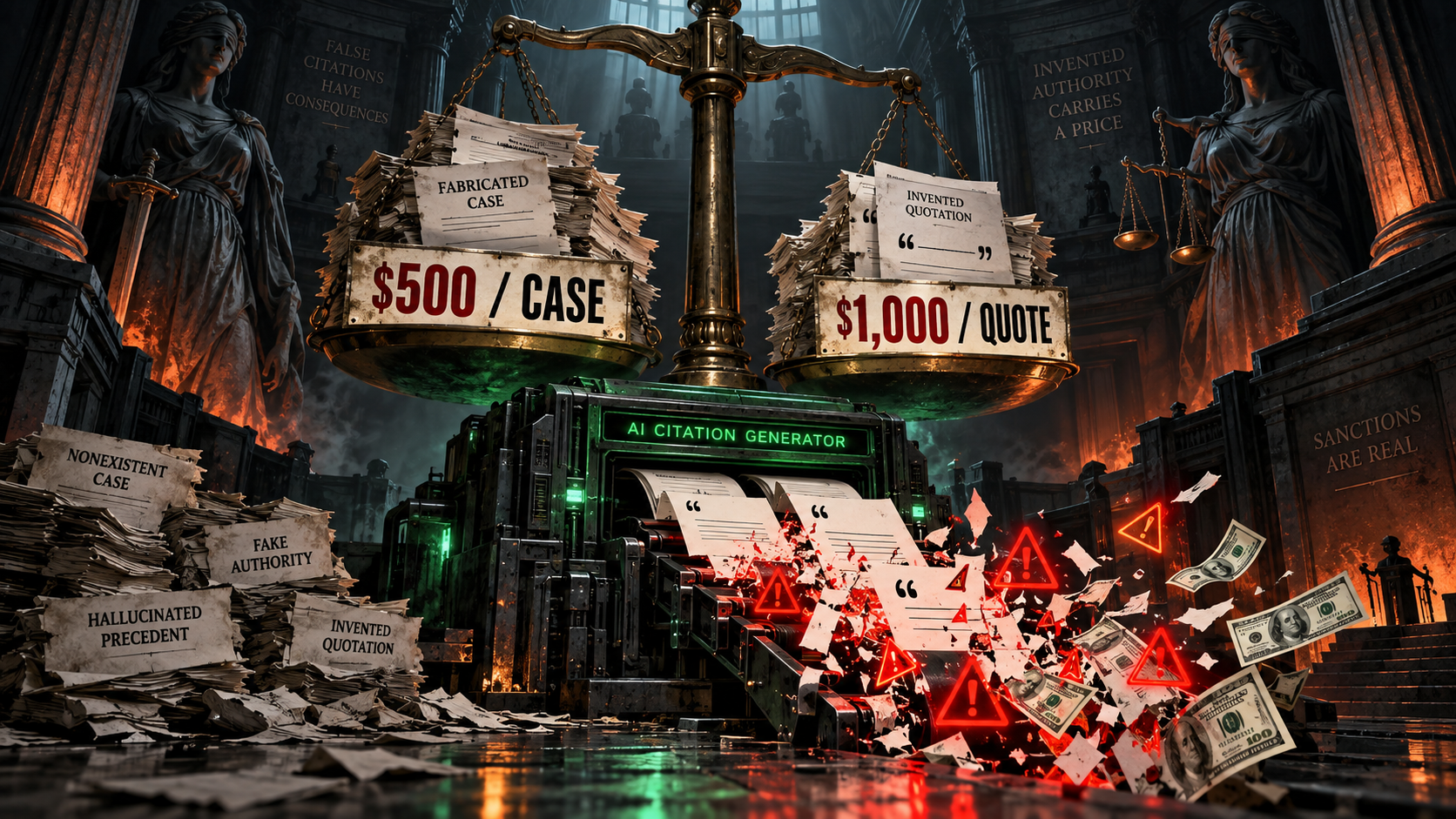
The Courts Stopped Being Patient
🔴 REAL INCIDENT: US federal and appellate courts — record AI citation sanctions (Q1 2026)
What Happened
For roughly three years, the standard judicial response to a lawyer filing AI-fabricated case citations was a reprimand, a small fine, and a written opinion expressing disappointment. The profession treated these as embarrassing anomalies — the Mata v. Avianca problem, a cautionary tale for CLE slides.
In the first quarter of 2026, that ended. US courts imposed at least $145,000 in sanctions for fabricated citations in three months.
The Oregon case set the record. In Couvrette v. Wisnovsky, a dispute over a winery, counsel filed 15 AI-generated fake citations and eight fabricated quotations across three summary judgment briefs. The court imposed $110,204.38 in combined sanctions, fines, and opposing party costs against the two lawyers involved — believed to be the largest aggregate AI-hallucination penalty on record in the United States.
The structure of that award is the part the profession should read twice. One attorney's share came to $95,998.72, broken into $15,500 in monetary sanctions paid to the court plus $80,498.72 in the defendants' attorney fees. And the $15,500 was not a round number pulled from judicial discretion. It was itemized: $500 for each non-existent case, $1,000 for each fabricated quotation.
A court had built a price list.
The appellate courts joined. The Sixth Circuit issued a $30,000 fine — reported as the steepest sanction tied to fabricated citations at the federal appellate level, and that figure was direct fines alone, before attorney fees and double costs.
In the Fifth Circuit's Fletcher v. Experian Information Solutions, counsel submitted a reply brief containing 16 instances of fabricated quotations and then misled the court about her use of generative AI. Sanction: $2,500 — modest in dollars, severe in the finding, because the aggravating factor was the misrepresentation rather than the citations.
In Lexos Media IP, LLC v. Overstock.com, Senior Judge Julie Robinson sanctioned five attorneys a total of $12,000 for patent infringement briefs containing nonexistent cases, fabricated quotations, and — most damning — citations to real cases that held the opposite of what the brief claimed they held.
Oregon's appellate courts went further than any single case and published a standing notice regarding sanctions for submission of fabricated authority produced by AI: formal advance warning that the court will penalize this conduct, removing any future argument that a lawyer did not know.
Trackers maintained by researchers monitoring generative AI in litigation have documented well over a thousand cases of hallucinated authority by lawyers — one count exceeding 1,148, another running past 1,500.
The Technical Breakdown
This is a professional-services failure mode, and the mechanics are worth separating from the moralizing.
Legal citations are the ideal hallucination substrate. A case citation is highly structured, highly patterned, and verifiable only against an external database. A language model can generate a citation that is perfectly formatted — plausible party names, a real reporter, a plausible volume and page, a real court, a plausible year — with no ability to confirm the case exists. The output looks more authoritative than a hedge would. There is no linguistic signal distinguishing a real citation from a fabricated one, which means proofreading cannot catch it. Only lookup can.
The third failure category is the dangerous one. The Lexos Media opinion identifies three distinct defects: nonexistent cases, fabricated quotations from real cases, and citations to real cases that held the opposite of the proposition asserted. The first is caught by any verification step — the case isn't there. The second is caught by opening the case. The third survives a citation check entirely. A lawyer confirming that every cite resolves to a real opinion will pass a brief containing authority that actively undermines their argument. Verification has to include reading, and "did you read the case" is a much harder control to enforce than "did the link work."
Volume outruns review. The efficiency gain is real: drafting a brief with AI assistance is genuinely faster. But research verification scales linearly with the number of citations while drafting time collapses. A workflow that produces briefs three times faster and verifies at the old pace will systematically ship unverified authority. The bottleneck moved and the process didn't.
The cover-up is now the aggravating factor. Fletcher drew its sanction as much for misleading the court about AI use as for the sixteen fabricated quotations. Multiple 2026 opinions follow this pattern. The fabrication is treated as negligence; the misrepresentation is treated as a candor violation — which is a different order of professional exposure, reaching bar discipline rather than a fee award.
Notice has been established. This is why the Oregon standing notice matters more than its own docket. "I didn't know the tool did that" was a survivable position in 2023. With published court notices, over a thousand tracked cases, bar guidance across jurisdictions, and a body of sanctions opinions, a 2026 filing with fabricated authority is no longer an accident a court will read charitably.
The Broader Pattern
Law is the visible edge of a failure mode running through every professional-services business: the deliverable is the product, and the deliverable now contains unverified machine output.
A brief is a lawyer's work product. A valuation model is a banker's. A report is a consultant's — and as we cover in the Deloitte Australia refund and EY retraction entries, the same defect has produced retracted studies and refunded government contracts. An audit memo, a clinical summary, a compliance filing, a due diligence report: in each case a client is buying professional judgment, and each is now assembled with tools that fabricate authoritative-looking detail at no cost and with no signal.
What makes the legal sector instructive is that it has a forcing function the others lack. A judge reads the filing. Opposing counsel has both the motive and the skill to check every citation. The error surfaces in public, on a docket, with a dollar figure attached and the lawyer's name on it.
Consulting, banking, and accounting have no equivalent adversary reading the deliverable line by line. Their hallucinations surface when a journalist, a researcher, or a regulator happens to look — which is to say, rarely, and long after the work has been relied upon. The legal sanctions data is not evidence that lawyers are worse at this. It is evidence that lawyers are the only ones being systematically caught.
The regulatory layer is now moving in behind. FINRA's 2026 Annual Regulatory Oversight Report added a dedicated generative AI section naming hallucinations and bias as risks firms must test for and govern. The question is shifting from whether a professional used AI to whether their firm had a documented verification control and can show it operated.
How It Could Have Been Prevented
- Make citation verification a mandatory, logged workflow step — not an expectation. Every authority in a filing gets checked against the source database, by a named person, with the check recorded. An expectation is what you have when you have no control. When sanctions arrive, the log is the difference between negligence and a defensible process that failed once.
- Verify the proposition, not just the existence of the case. Lexos Media is the case that proves link-checking is insufficient. The reviewer must confirm the cited authority actually supports the assertion it is cited for. Build that into the checklist explicitly, because it will otherwise be skipped as the slow step.
- Use retrieval-grounded legal research tools rather than open-ended generation. A system that retrieves from an actual case database and cites what it retrieved has a fundamentally different error profile than a model generating citations from parameters. It is not a complete answer — retrieval systems still mischaracterize holdings — but it eliminates the wholly-invented case.
- Require written disclosure of AI use in the drafting workflow, internally. Not because AI use is improper, but because Fletcher shows the misrepresentation is what converts a fee sanction into a candor problem. A lawyer who has already documented their tool use internally is not making a decision under pressure when a judge asks.
- Scale review capacity with drafting capacity. If AI triples drafting throughput, verification staffing has to move with it. Firms capturing the speed gain while holding review flat are building the Oregon fact pattern on purpose.
- Price the risk honestly in the business case. The Oregon award was $110,204.38 against two lawyers, of which $80,498.72 was the other side's fees. Against that, the hours saved by skipping verification on a summary judgment brief are not a rounding error in the firm's favor.
The Lesson
The $500-per-invented-case, $1,000-per-fabricated-quotation calibration in the Oregon sanction is the single most significant development here, and it has almost nothing to do with the dollar amounts.
It means a court has stopped treating AI hallucinations as an aberration requiring a bespoke response and started treating them as a recurring category of professional misconduct with a schedule. You do not build a per-unit price list for something you expect to see once. You build one for something you expect to see regularly, from many different lawyers, and want to dispose of consistently. That is an institution adjusting to a permanent condition.
For every professional-services firm, the implication is the same regardless of sector. The tolerance window — the period in which "the AI did it" was a novel and partially sympathetic explanation — has closed. What replaces it is a standard that will feel familiar to anyone who has worked under a regulator: you are responsible for your work product, the tool's behavior is not a defense, and the question we will ask after the fact is what control you had in place.
The lawyers sanctioned in Q1 2026 were not reckless outliers. They were, overwhelmingly, competent practitioners who used a tool that produces fluent, well-formatted, confident, wrong output, and who applied the review process they had always applied — a process built for a world where a citation appearing in a draft meant a human had found it somewhere.
That assumption is gone. Nothing in the workflow announced its departure.
Take your firm's last ten client deliverables. For each one, identify the specific person who verified each external factual claim against its source, and the record showing they did. If that record does not exist, your verification control is an assumption — and the Oregon court has published what assumptions now cost, itemized.
Sources
- EDRM / ComplexDiscovery — "The AI Sanction Wave: $145K in Q1 Penalties Signals Courts Have Lost Patience with GenAI Filing Failures," April 2026
- ABA Journal — "Federal judge hands down $110K penalty against 2 lawyers for AI errors in court documents," 2026
- Norton Rose Fulbright — "AI in litigation: Update on Gen AI sanctions in 2026"
- Oregon Judicial Department — "Notice Regarding Court Imposition of Sanctions for Submission of Fabricated Authority Produced by AI"
- OPB — "AI fabrications in legal filings grow in Oregon, US," May 10, 2026