
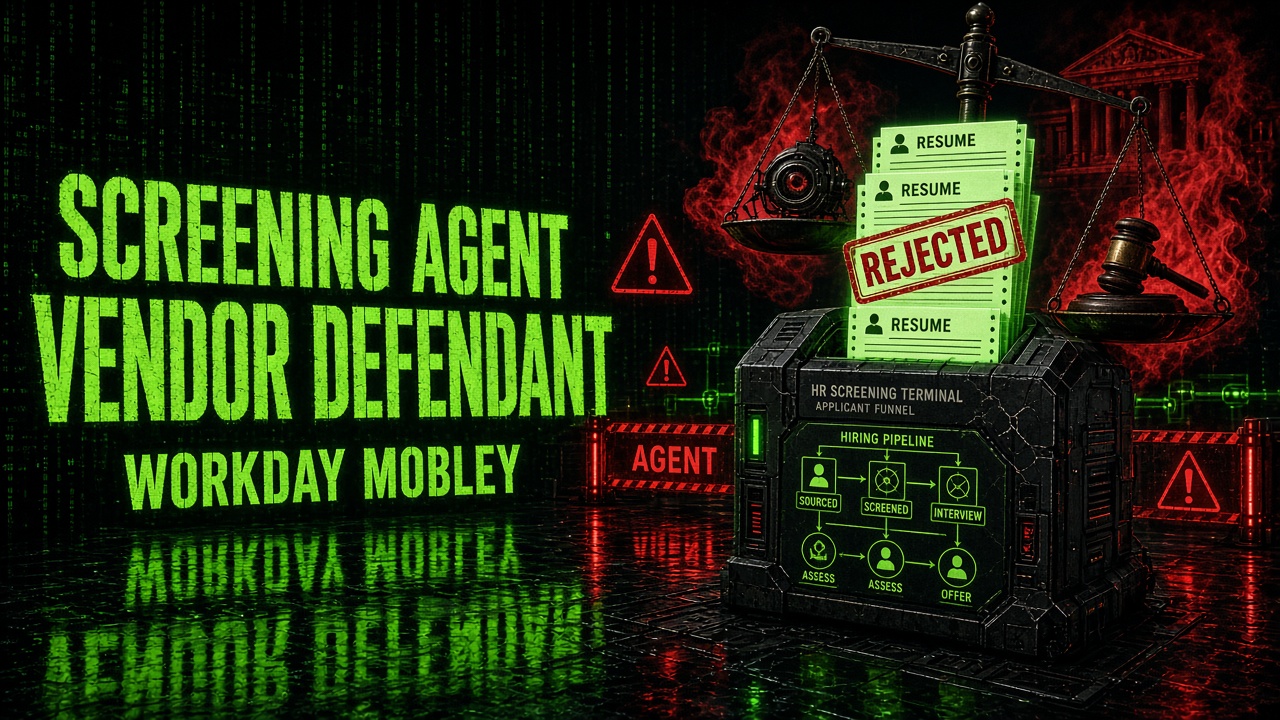
🔴 REAL INCIDENT: Mobley v. Workday, Inc. — AI hiring-tool claims survive dismissal; ADEA collective conditionally certified (N.D. Cal. 2024–2025)
What Happened
Derek Mobley alleges a pattern every job seeker dreads: apply, wait, get nothing. Again. And again.
In a putative class and collective action in the Northern District of California, Mobley claimed he applied to at least 80–100 (later filings: 100-plus) positions at employers using Workday screening tools—and was denied every time. Other named plaintiffs over age 40 allege similar near-total rejection without interviews.
The suit does not claim Workday was Mobley's employer. It claims something more unsettling for the AI-tools market: that Workday's AI-based recommendation and screening systems can make Workday liable as an agent of the employers who deploy them—under Title VII, the ADA, and the ADEA—when those tools score, rank, screen, or effectively gatekeep candidates.
On July 12, 2024, the district court denied Workday's second motion to dismiss in key respects. As alleged, Workday could be treated as an agent of employer-customers. Disparate-impact claims were allowed to proceed. Intentional-discrimination claims were dismissed (leave possible if discovery later showed intent).
On May 16, 2025, the same court granted preliminary / conditional certification of Mobley's ADEA collective—notice to similarly situated applicants age 40+, with opt-in—without deciding the merits.
Workday has not been found liable. The case is about whether claims proceed, and in what form. That alone rearranges how vendors and buyers think about AI agents in hiring.
Who Ran It / What Broke (As Alleged)
Who ran the tools: Workday, Inc., a major cloud HR and recruiting provider. Its recruiting suite includes AI/ML features that plaintiffs allege score, rank, or recommend candidates—and that, in many deployments, candidates cannot advance unless they clear those screens.
What broke—legally, not technically: The assumption that "we're just software" keeps the vendor outside federal employment discrimination statutes when the software performs traditional hiring functions.
Plaintiffs allege the tools rely on biased training data or amplify historical bias, producing disparate impact by race, age, and disability. They allege a unified policy: use of Workday's AI recommendation system to score, sort, rank, or screen applicants.
Workday has disputed core premises—including that it "recommends" hires as plaintiffs describe, and that any single uniform policy applies across customers who configure features differently. Those fights are for later. At dismissal and conditional certification, the court asked whether the allegations state claims and support collective notice.
The July 2024 Ruling: Agent, Not Employment Agency
From the July 12, 2024 order (as summarized in contemporaneous analyses):
- Anti-discrimination statutes reach employers and their agents.
- Mobley sufficiently alleged that customers delegate traditional hiring functions—including rejecting or advancing candidates—to Workday's algorithmic tools.
- The court warned that walling off software decisionmakers from human ones could "potentially gut" anti-discrimination law in the modern era.
- The EEOC filed an amicus brief supporting vendor coverage theories; the court accepted the agent path but rejected the "employment agency" theory on the pleadings before it.
- Disparate-impact allegations were found plausible enough to proceed—volume and timing of rejections plus literature on biased training data—as alleged, not proven.
- Intent claims were dismissed for inadequate allegations of discriminatory intent.
The May 2025 ADEA Conditional Certification
Preliminary collective certification under the ADEA is a notice gate, not a merits win. The bar is relatively low: substantial allegations that the named plaintiff is similarly situated to the proposed collective.
The court found Mobley had adequately alleged a unified policy—the AI system's scoring/sorting/ranking/screening—and that age-40+ applicants' claims could rise and fall together for notice purposes. Individual differences across jobs and employers did not defeat conditional certification at this stage.
Workday argued tools and configurations vary by customer. The court was not persuaded for notice purposes.
Size became a headline. In filings, Workday represented that on the order of 1.1 billion applications were processed/rejected through its tools during the relevant period, and warned notice could invite hundreds of millions of potential plaintiffs. That figure is Workday's representation about application volume—not a finding of discriminatory rejections.
After discovery, Workday can seek decertification. The May order does not resolve whether the tools caused age-based disparate impact.
Why This Belongs in the Horror Show
Hiring AI is sold as triage: score the flood, recommend the best, keep humans for the final mile.
Mobley reframes that product as a decision agent inside the employer's selection process. If the agent can auto-disposition or materially decide who advances, plaintiffs will argue—and at least one federal court has allowed them to argue—that the vendor stands in the employer's shoes for statutory purposes.
The horror is quiet:
- Scale without shared auditability across vendor and customer.
- Statistical harm theories that do not require proof of bad intent.
- Contracts that called the vendor "just a tool" while the product marketed autonomous screening.
- A collective-notice machine that can turn one plaintiff's story into nationwide opt-in outreach.
The Governance Gap
Whether or not plaintiffs ultimately prove disparate impact, the operational lesson is live:
1. Know what the agent decides. If it rejects, ranks, or blocks interview access, document that function—internally and in contracts.
2. Audit outcomes, not slogans. Disparate-impact exposure is statistical. If you cannot measure selection rates by protected class across stages the tool touches, you are flying blind.
3. Keep a human-accountable control point. Courts look at delegated traditional hiring functions. Ambiguity about who overrides a screen is itself risk.
4. Align vendor–customer liability and evidence access. Logs, configurations, and override records become the case.
Control and ops are not a product pitch. They are how you survive discovery.
Takeaway
Mobley does not establish that Workday's AI discriminated. It establishes that allegations of AI gatekeeping can clear motions to dismiss and support conditional ADEA collective notice—with the vendor, not only the hiring employer, in the defendant seat.
If your recruiting stack includes an AI agent that scores or screens people, assume plaintiffs' lawyers will treat that agent as part of the employer's decision process. Design oversight, measurement, and contractual clarity accordingly—before a court decides how much of the hiring function you already delegated.
Sources
- Epstein Becker Green Workforce Bulletin on the July 12, 2024 N.D. Cal. order (*Mobley v. Workday*)
- Davis Wright Tremaine: preliminary ADEA collective certification analysis (May 2025 order)
- Proskauer *Law and the Workplace*: conditional certification milestone and 1.1B applications figure from filings (June 2025)
- Case: Mobley v. Workday, Inc., N.D. Cal. No. 3:23-cv-00770